The ocean is home to numerous amazing creatures, but few are as amazing as the solar-powered sea slug. This small marine animal has attracted the attention of scientists and nature lovers across the world because of its amazing ability to obtain energy from sunlight, commonly known as the “solar-powered sea slug.” This creature shows one of the most special survival adaptations found in nature.
The leaf sheep is one of the most popular examples of a solar-powered sea slug (Costasiella kuroshimae), a small marine gastropod famous for its cute appearance and plant-like features. While it may look like a cartoon character, this tiny sea slug has an amazing biological capability that appears nearly impossible to capture from algae and use them to generate energy through photosynthesis just like plant.
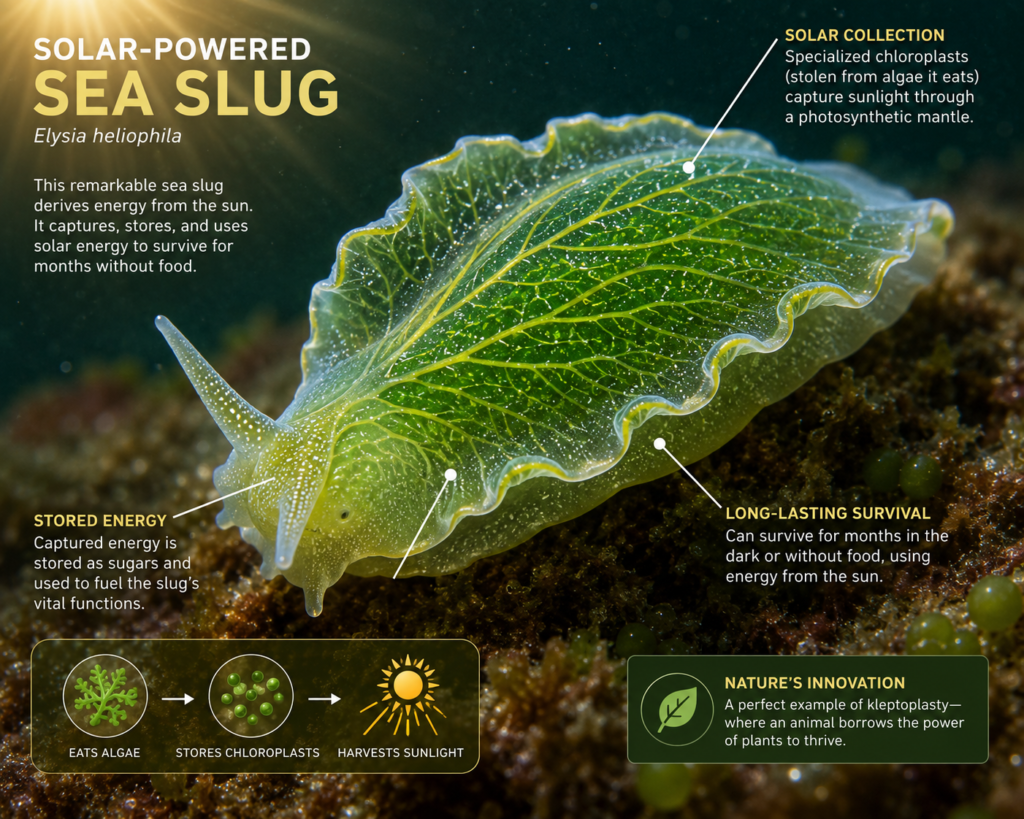
What Is a Solar-Powered Sea Slug?
A solar-powered sea slug is a marine mollusk that can use chloroplasts taken from algae to produce energy from sunlight. Chloroplasts are expert structures present in plant and algal cells that carry out photosynthesis, the process of converting sunlight into chemical energy.
Unlike plants, sea slug unable to make their own chloroplasts; rather, they obtain them by taking food from algae . In the process of digestion, the slug carefully divides the chloroplasts from the remaining part of the algal cell and stores them inside its own tissues. These stolen chloroplasts continue working and continue generating energy from the sea slug.
This amazing process is called kleptoplasty, which actually means stolen plastids. It makes it possible for certain sea slugs to enhance their diet with energy produced directly from sunlight.
The Popular Leaf Sheep Sea Slug
In the middle of all solar-powered sea slugs that leaf sheep sea slug is possibly the most famous. Originally found in the water of Indonesia, the Philippines, and Japan, this small creature commonly measures more than one centimeter in length.
Its body is covered with countless leaf-like limbs called cerata. These structures hold on to the stolen chloroplasts and help to increase exposure to sunlight. The shining green coloration of leaf sheep comes from these chloroplasts, giving it the appearance of a small underwater plant.
Because of its adorable face and sheep-like appearance, the leaf sheep has gained internet fame; however, outside its cute looks lies one of the most interesting examples of biological adaptation in the ocean.
How Sea Slugs Use Photosynthesis?
The process starts when the sea slug consumes a specific kind of algae using specialized feeding structures. It punctures the algae cells and removes their contents instead of breaking down everything the slug keeping chloroplast selectively.
These chloroplasts are moved into cells covering the digestive system. As long as they are active when sunlight arrives, the slug’s body uses the chloroplast to complete photosynthesis and creates sugars that give more energy.
Even though sea slugs still need to feed on algae regularly, photosynthesis supports their survival during times when food is limited. In some species, stolen chloroplasts can be maintained functionally for over a period of weeks or months.
Scientists continue to research sea slugs that keep these chloroplasts for such a long period. Usually, chloroplasts depend upon proteins provided by the plant cell nucleus, the fact that they remain functional inside the remains of ananimal is one of biology’s most interesting mysteries.
Living Environment and Range
Solar-Powered sea slugs are usually found in warm coastal waters where algae are plentiful; they live in coral reefs, tide pools, shallow marine environments, and rocky shorelines.
The leaf sheep sea slug is generally found within green algae, where it eats and joins together into its environment; its green coloration gives outstanding camouflage, helping it stay away from predators while looking for food.
These habitats play an important role in the survival of marine sea slugs. A strong marine ecosystem promotes algae growth, which gives both food and chloroplasts environmental changes that destroy these ecosystems that can not directly affect sea slug populations.
Ecological Significance
Although they are small, solar-powered sea slugs help maintain the balance of the marine ecosystem by eating algae, they help control algal development, and engage in complex food webs.
Their special participation with algae shows the independent nature of marine life awareness. These relationships help scientists obtain knowledge into ecosystem interaction and biodiversity.
Further, sea slugs act as a sign of environmental health. Variations in their population may represent broader ecological problems like pollution, habitat destruction, or global warming.
Value In Scientific Research
The Solar-Powered sea slug has turned into a valuable subject of scientific research, its capability to stay functional with chloroplasts challenges conventional assumptions about the boundary between plant and animal biology.
Scientists wish that studying kleptoplasty may give important understanding into photosynthesis cellular interaction and energy generation. Some researchers feel that knowledge of this process could ultimately assist in advances in biotechnology and natural energy sources.
The sea slug’s amazing transformation also raises questions about assessing how these animals came to develop this ability to apply chloroplasts. What biological methods allow them to maintain these structures? These questions keep going to motivate scientific examination.
Dangers and Preservation
As with many marine creatures, solar-powered sea slugs deal with several environmental issues: habitat loss, ocean temperature rise, pollution, and poor water quality, which risk the ecosystem on which they depend.
Coral reef decline and coastal growth can decrease the availability of ideal habitats and food supply. Plastic pollution also poses risks to marine life by showing dangerous elements into sea environment.
Preservation attempts directed at protecting marine ecosystem advantages solar-powered sea slug and numerous other species, creating a marine conservation zone, decreasing pollution, supporting sustaiable fishing practices, and helping environmental education can all add to healthier oceans.
An individual can assist by reducing waste, reducing plastic consumption, and helping organizations committed to marine conservation.
Summary
The solar-powered sea slug is one of nature’s most amazing creations. By means of an extraordinary system of kleptoplasty, these small animals remove the boundary between plants and animals by using solar energy from sunlight. Their capability to take and use chloroplasts reflects a special evolutionary adaptation that remains ongoing to attract scientists worldwide.
From the charming leaf sheep sea slug to other photosynthetic species, these creatures show the amazing diversity and innovation established in marine ecosystems. The research is ongoing. Solar-powered sea slug may provide valuable insights into biology, ecology, and clean energy.
Defending the oceans that support these amazing organisms is important for maintaining biodiversity and securing the future generations can continue to be amazed by the wonders of the natural environment. The solar-powered sea slug serves as a strong reminder that even tiny creatures can possess amazing abilities that challenge our knowledge of life itself.